

The U.S. Court of Appeals for the District of Columbia Circuit denied pipe-bomb suspect Brian Cole Jr.’s bid for release from jail pending trial on four explosives-related charges.
A three-judge panel issued a ruling but said it did not feel the need to issue an opinion in the case. The judges affirmed rulings by a magistrate judge and a district judge in Washington D.C. who ruled no conditions of release would adequately protect the community.
The justices issuing the ruling included Julianna Michelle Childs and Bradley Nelson Garcia, appointed to the bench by President Joe Biden; and Justin R. Walker, a President Donald J. Trump appointee.
The appeals panel rebuffed defense contentions that Cole’s rights were violated because he did not have a preliminary hearing in the nearly month-long period from his Dec. 4 arrest until Dec. 30. Felony defendants must either be charged by indictment or be given a preliminary hearing to determine probable cause within 14 days of a first court appearance. Cole was initially charged by criminal complaint. He first appeared in federal court on Dec. 5.

Defense attorneys wrote that the magistrate judge is responsible to make sure a preliminary hearing is scheduled if an indictment is not forthcoming from the U.S. Department of Justice.
The record does not reflect that the district court failed to adequately consider relevant evidence or arguments offered by appellant in support of release…”
Instead, the judges seemed to imply it was Cole’s responsibility to ask his attorney for a preliminary hearing at the time of his first appearance on Dec. 5. The defense asked Magistrate Judge Matthew Sharbaugh to hold a preliminary hearing on Dec. 30 in combination with the previously scheduled detention hearing.
Sharbaugh rejected the request. He gave federal prosecutors extra time to obtain a federal indictment, which was handed up on Jan. 6. On Dec. 29, the DOJ had obtained an indictment from a District Of Columbia Superior Court grand jury. Defense attorneys argued that a Superior Court indictment is not valid in U.S. District Court. That legal point is being argued in another appeals case from the District of Columbia.
“At appellant’s initial appearance on December 5, 2025, the district court ordered
appellant’s temporary detention, scheduled a detention hearing for December 15, and
advised appellant that if he wished to invoke his right to a preliminary hearing at which
probable cause would be determined, he should so inform his attorney,” the ruling said.
Extraordinary circumstances
Magistrate Judge Sharbaugh ruled Dec. 30 that the D.C. Superior Court grand jury indictment “presented extraordinary circumstances warranting a brief continuance of any preliminary hearing pending a decision on the indictment’s validity,” the appeals ruling said.
The Court of Appeals affirmed a Jan. 16 ruling by U.S. District Judge Amir H. Ali that Cole should continue to be held until trial. Judge Ali’s ruling came after an emergency defense motion for reconsideration of Magistrate Judge Sharbaugh’s earlier detention ruling.
Cole, 30, of Woodbridge, Va., was arrested at his home on Dec. 4 as the FBI raided the residence and executed a search warrant. He was questioned by the FBI for some four hours without an attorney present. The DOJ said Cole waived his right to have an attorney present and consented to delay his first appearance by a day.
Cole is charged with three federal counts: interstate transportation of explosives, malicious attempt to use explosives, and attempt to use weapons of mass destruction; and one D.C. charge: an act of terrorism while armed. Those charges were leveled in an April 14 superseding indictment handed up by a federal grand jury in Washington D.C.
The appeals panel was not swayed by the defense arguments that Judge Ali failed to consider relevant evidence brought forth by Cole’s attorneys.
“…The record does not reflect that the district court failed to adequately consider relevant evidence or arguments offered by appellant in support of release, such that remand would be warranted,” the ruling said.
Prosecutors said that after denying for two hours any involvement in the dropping of two pipe bombs on Capitol Hill the night of Jan. 5, 2021, Cole then confessed to being the pipe bomber and provided extensive details to FBI special agents.
The FBI said it also found what it called bomb-making materials in Cole’s Nissan Sentra parked on the street near the family home. Cole had apparently been collecting dual-use items such as pipe nipples, wire, steel wool, and some chemicals that can be used to make black powder but are also used for other purposes, such as insecticides. Some of the items were purchased years before Jan. 6, 2021.
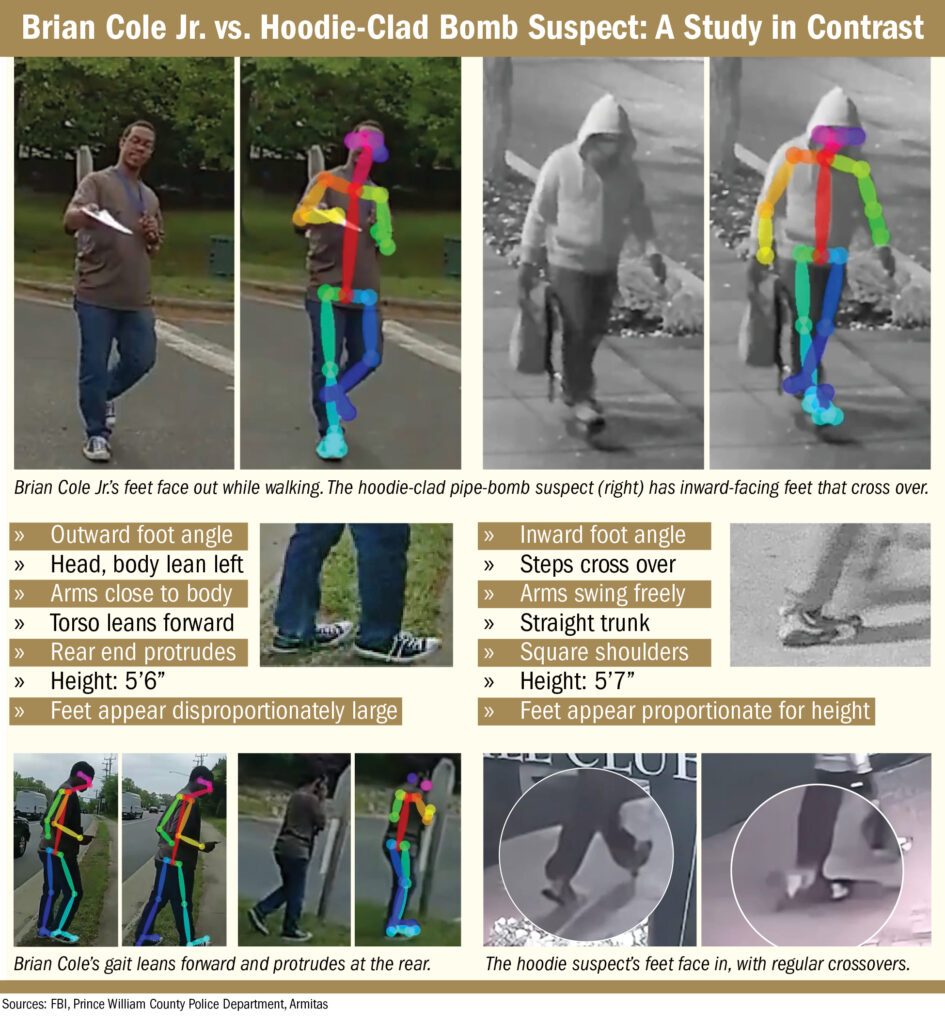
The arrest and indictment raised serious issues from the start, as detailed in a series of articles by Blaze News [ PART I | PART II | PART III] that compared Cole to the hoodie-clad suspect shown on FBI video. The growing list of conflicts includes Cole’s height, body shape, size 12 shoes, gait, autism spectrum disorder, obsessive compulsive disorder, and his physical location at the time the devices were placed.
At a recent status hearing in Washington D.C., defense attorney J. Alex Little said the defense would be ready for trial by year’s end and asked for a trial date to be set.
The Court of Appeals stayed publication of the mandate in the case for seven days beyond the resolution of any timely requests for a rehearing by the three-judge panel, or a rehearing en banc by the entire 11-judge District of Columbia panel. •
Discover more from Veritas Regnat
Subscribe to get the latest posts sent to your email.