

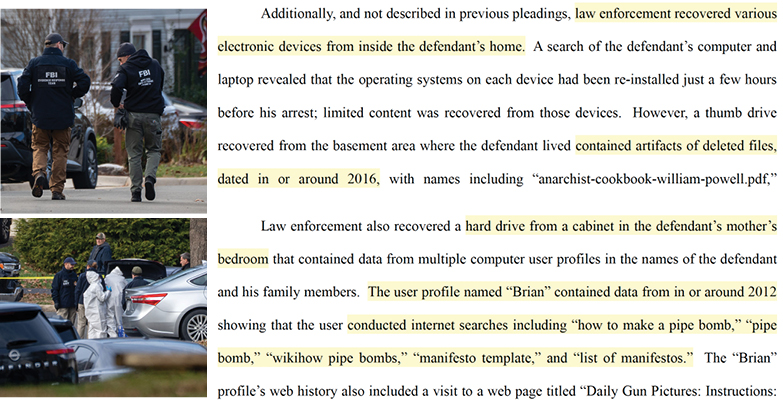
When the FBI searched pipe-bomb suspect Brian Cole Jr.’s Virginia home on Dec. 4, agents found a hard drive in his mother’s bedroom on which a computer account labeled ‘Brian’ had conducted internet searches in 2012 using terms such as “how to make a pipe bomb” and “manifesto template,” federal prosecutors alleged April 10.
The U.S. Department of Justice tucked that previously undisclosed information in a memo filed with U.S. District Judge Amir Ali opposing an effort by two of Cole’s lawyers claiming Cole is exempt from pipe-bomb criminal charges due to President Donald J. Trump’s pardon declaration of Jan. 20, 2025.
“Ms. Kerkhoff failed the polygraph.”
The “Brian” profile on the hard drive made internet searches “in or around” 2012 using terms including “how to make a pipe bomb,” “pipe bomb,” “wikihow pipe bombs,” “manifesto template” and “list of manifestos,” prosecutors wrote in a 21-page federal court filing.
That user profile had also visited a web page titled, “Daily Gun Pictures: How to make a homemade pipe bomb,” the DOJ said.

The DOJ filing did not explain how it connected or intends to connect the computer data to the defendant, as opposed to his same-name father, Brian Cole Sr., or some other individual. Brian Jr. was 17 or 18 at the time those searches were allegedly made.
A thumb drive recovered from the home’s basement in the “area where the defendant lived” contained “artifacts of deleted files” from in or around 2016 with names including, “anarchist cookbook-william-powell,” “anarchistcookbook2000,” “chemical equivalency list,” “is this still the land of the free,” “revolutionary armed front,” and “revolutionary handbook,” prosecutors said.
William Powell was a then-teenage Vietnam War-era radical who wrote “The Anarchist Handbook,” which was in essence a terrorist’s how-to guide. The 1971 book offers lessons on building explosives such as car bombs and booby traps, how to blow up bridges and other structures, how to make TNT, how to make a silencer for a firearm, and how to manufacture all sorts of illegal street drugs, among myriad other topics.
Later in life Powell repeatedly renounced the book and unsuccessfully campaigned to have it removed from circulation. The book is still in print today. Powell died in July 2016 at age 66.
The FBI says Cole made a confession to agents on Dec. 4 after initially denying any involvement with the pipe bombs for two hours. In that alleged confession, Cole said placing the bombs at the Democratic National Committee and near the Republican National Committee on Jan. 5, 2021, was not related to Jan. 6. But it was, according to the alleged confession, related to concerns about fraud in the 2020 presidential election. That was the driving force behind protests at the U.S. Capitol on Jan. 6.
The FBI “sent surveillance of her walking to a podiatrist, likely for a gait analysis.”
Prosecutors said Cole’s computer and laptop computer had the operating systems reinstalled just hours before his Dec. 4 arrest and only “limited content was recovered from those devices.”
In the main body of the April 10 filing, the DOJ argued that President Trump’s pardon declaration only included those convicted of Jan. 6 crimes and defendants whose cases were still pending in federal court as of Jan. 20, 2025. Retroactively applying the pardon declaration to Cole’s case goes against a plain reading of the pardon text, the DOJ wrote.
‘Did you place those pipe bombs?’
Defense attorneys have slipped some bombshell information of their own in a recent motion for the early return of subpoenas. They alleged that the FBI opened a pipe-bomb investigation on former Capitol Police officer Shauni Kerkhoff days before Blaze Media published a story stating she was a forensic match to the hoodie-clad suspect on FBI video.
According to the defense filing, Kerkhoff was questioned by the FBI on Nov. 6, 2025 and given a polygraph examination. Among the questions asked were, “Did you place those pipe bombs?” and, “Did you place those pipe bombs that evening?”
“Ms. Kerkhoff failed the polygraph,” defense attorneys said in an April 1 court filing. “The FBI polygraph examiner noted Kerkhoff’s ‘very controlled reaction’ to the news of her failing the polygraph and seemingly rehearsed responses to examiner’s questions.”
The FBI and DOJ issued “subpoenas and preservation requests for numerous electronic accounts associated with Ms. Kerkhoff,” defense attorneys wrote April 1.
Agents “attempted to question” Kerkhoff and her boyfriend, Capitol Police officer Daniel Dickert, at their residence. Agents interviewed Kerkhoff’s dog walker, her neighbors and Capitol Police co-workers. They also “surveilled her without her knowledge” and “sent surveillance footage of her walking to a podiatrist, likely for a gait analysis.”
Defense attorneys drafted a subpoena for Dr. Michael Nirenberg of Crown Point, Ind., a forensic podiatrist who has testified in criminal court using gait analysis to link suspects to crime scenes. The defense wants to obtain any report Dr. Nirenberg produced analyzing Kerkhoff’s manner of walking.
The same day, prosecutors filed a court motion asking for a show-cause hearing to determine why defense attorneys should not be held in contempt of court for filing un-redacted versions of subpoenas drafted for Kerkhoff, Dickert and Nirenberg to the public case docket. The DOJ claims that violated the court’s evidence protective order.
The defense awaits a ruling from the U.S. Court of Appeals on its challenge to the detention order that has kept Cole in the Rappahannock County, Va., jail since Dec. 4. The defense argued that prosecutors violated the law and Cole’s rights by not holding a preliminary hearing or filing a grand jury indictment against Cole within two weeks of his first court appearance in December. •