

By Joseph M. Hanneman || April 17, 2026
A federal grand jury indictment handed up April 14 adds two terrorism-related charges against Jan. 6 pipe-bomb suspect Brian J. Cole Jr., bringing his charged total counts to four.
A superseding indictment posted to the case docket on April 15 charges Cole with one count of the use of weapons of mass destruction by allegedly planting pipe bombs at the Democratic National Committee building and near the Republican National Committee building the evening of Jan. 5, 2021.
Cole was also charged under District of Columbia code with one count of an act of terrorism while armed, for the “attempted malicious burning, destruction or injury of property.”
The original grand jury indictment dated Jan. 6, 2026, charged Cole with interstate transportation of explosives, and a malicious attempt to use explosives. The interstate transportation charge has a five-year statute of limitations that expired on Jan. 5, 2026, the Cole defense argues. The first federal indictment of Cole was dated Jan. 6, a day after the statute of limitations expired.
The U.S. Department of Justice obtained an indictment against Cole in District of Columbia Superior Court, not a federal court, on Dec. 29, 2025. The DOJ argues that indictment avoids the statute of limitations issue.
The defense argued that a federal district court cannot accept as valid an indictment from a non-federal court. That issue is part of an appeal Cole filed Feb. 5 with the U.S. Court of Appeals for the District of Columbia Circuit. The circuit court has not yet ruled on the appeal.
The four charges lodged against Cole carry possible prison time up to 20 years.
DOJ seeks sanctions
Cole will be in U.S. District Court in Washington D.C. on April 21 for a status hearing. There are a lot of issues that could come up, including the DOJ’s attempt to have defense attorneys held in contempt for posting on the public docket three subpoenas.
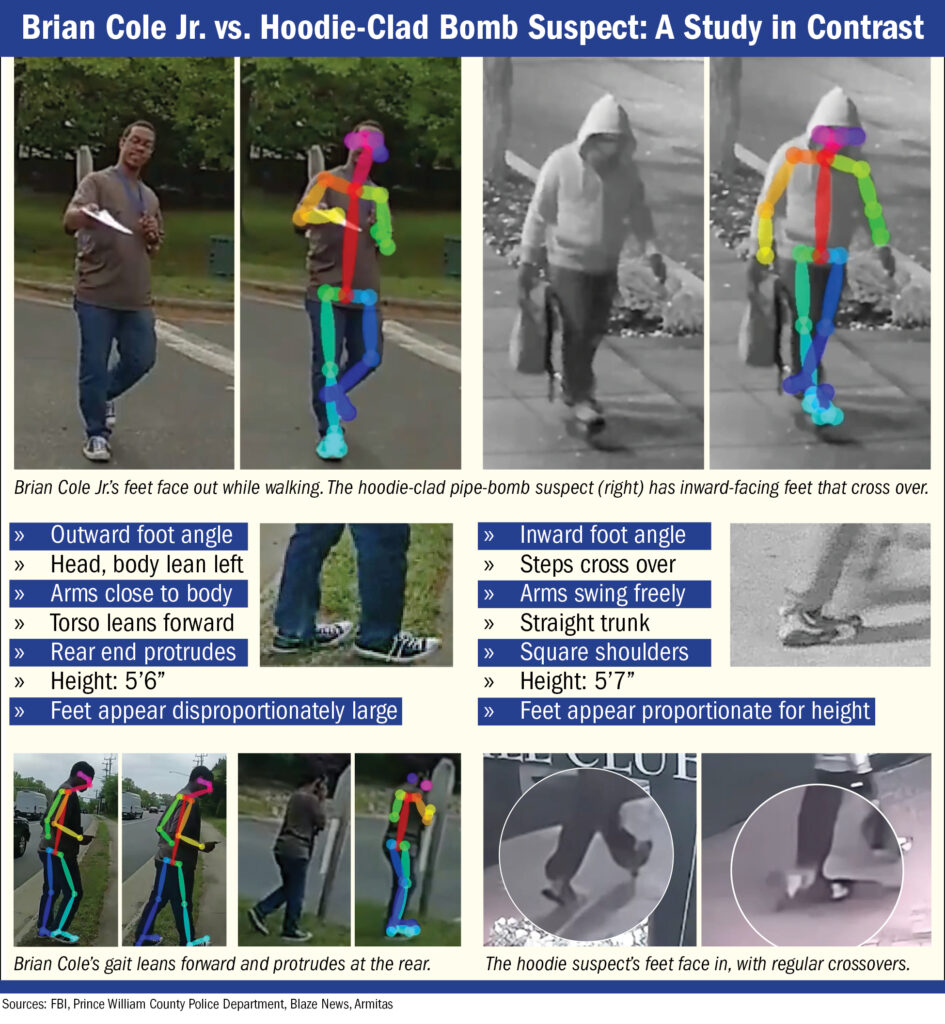
Among those named in the subpoenas are former Capitol Police officer Shauni Rae Kerkhoff, who was identified in a Nov. 8 Blaze Media story as a forensic match to the hoodie-clad bomb suspect, using gait analysis.
According to defense filings, Kerkhoff became a person of interest in the pipe bomb case on Nov. 6, two days before the Blaze article was published.
The FBI administered a polygraph exam on Nov. 6, which the defense says Kerkhoff failed. The FBI examiner said the results indicated signs of deception, and evidence of Kerkhoff was giving rehearsed answers. Among the questions asked by the polygraph examiner: “Did you place those pipe bombs?” and “Did you place those pipe bombs that evening?”
The other subpoenas were for Capitol Police officer Daniel Dickert, described as Kerkhoff’s boyfriend who lives with her in northern Virginia; and Dr. Michael Nirenberg, a forensic podiatrist who apparently did a gait analysis on Kerkhoff for the FBI.
Six days after Kerkhoff’s alleged polygraph failure, the FBI opened an investigation on Cole, 30, of Woodbridge, Va. Attorney General Pam Bondi and FBI Director Kash Patel said Cole’s Dec. 4 arrest was not based on any new evidence but on a re-examination of information already part of FBI files. •